To position Hung Yen at the central hub of the Capital Region and the Red River Delta
On October 12, Hung Yen province held a conference to announce its provincial master plan for the 2021–2030 period, with a vision extending to 2050. This event holds special political and socio-economic significance, marking a historic milestone and opening an ambitious new chapter in the province's development journey.
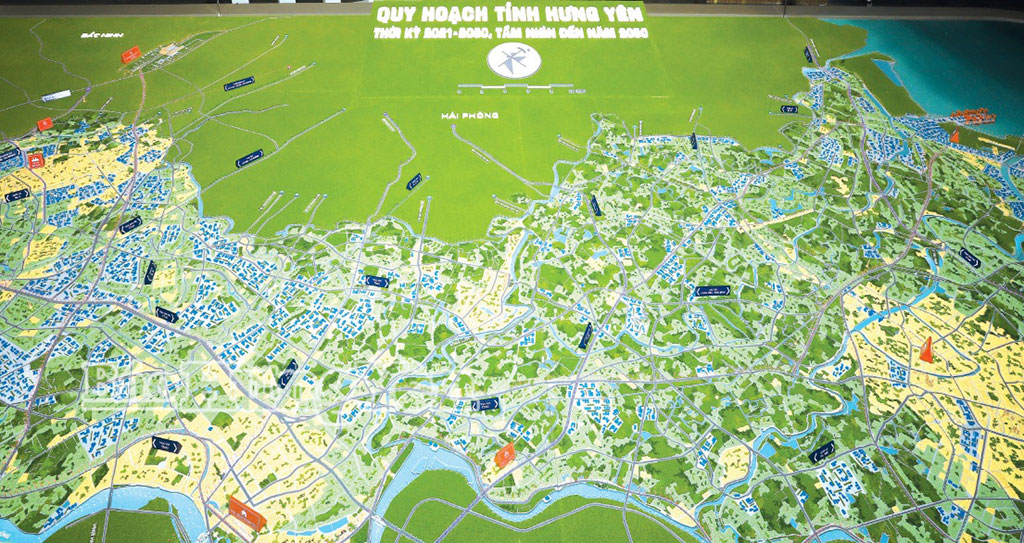
The scale model of the Hung Yen provincial master plan (2021–2030, vision to 2050).
Effective since July 1, 2025, the new Hung Yen province has been established through the merger of the entire natural area and population of the former Hung Yen province and Thai Binh province. Following the merger, the new Hung Yen province possess a natural area of over 2,500 km², a population of 3.5 million, and 104 commune-level administrative units. Strategically located adjacent to the capital, Hanoi, and the Northern Key Economic Region, the province enjoys expanded development space to foster urban systems, industry, high-tech sectors, logistics, services, tourism, high-tech agriculture, and the marine economy.
Immediately upon commencing operations, the provincial Party Committee and administration began formulating a long-term development plan for the new province. One of the tasks the province prioritized early on was the adjustment of its provincial master plan for the 2021–2030 period, with a vision extending to 2050.
This was an objective and urgent requirement aimed at integrating and reorganizing development space; mobilizing, allocating, and efficiently utilizing resources; and establishing growth drivers aligned with the province's scale, status, and new potential. Mr. Nguyen Manh Quyen, Deputy Secretary of the Provincial Party Committee and Chairman of the Provincial People's Committee, affirmed that the Hung Yen provincial master plan (2021–2030, vision to 2050) was developed with great dedication, meticulousness, and a methodical, scientific, and rigorous approach. It benefited from the guidance and responsible contributions of central agencies, ministries, and sectors, and incorporated extensive public feedback, gathered openly from agencies, experts, scientists, and the business community, as well as the heartfelt input of the province's residents.
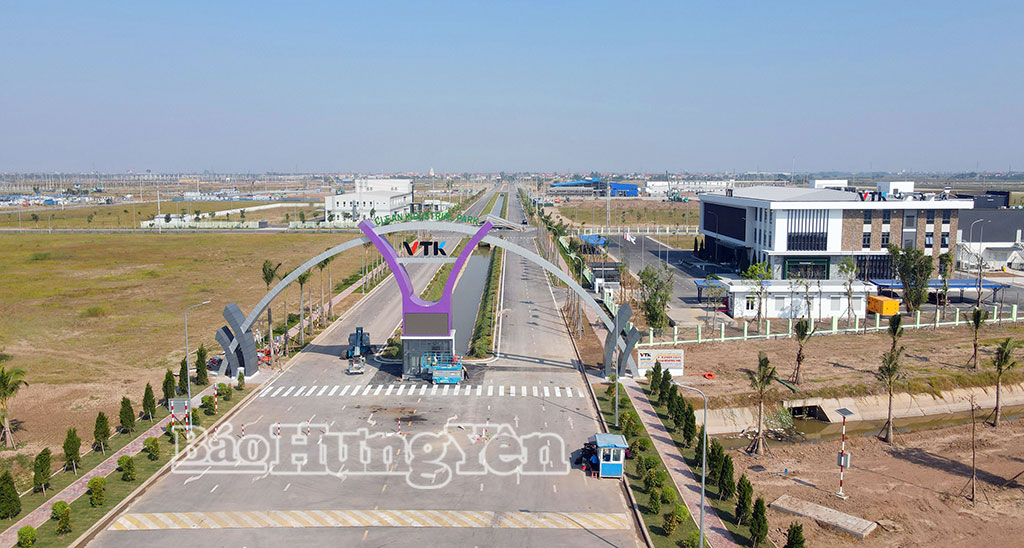
Hung Yen has finalized its industrial infrastructure plan, comprising one economic zone, one high-tech park, 66 industrial zones, and 115 industrial clusters, thereby standing ready to welcome both domestic and foreign direct investment (FDI) capital.
Building upon the province's strategic location and the significant potential and advantages gained following its consolidation, the Hung Yen provincial master plan (2021–2030, vision to 2050) has been finalized to align with national and regional master plans; notably, it positions Hung Yen as a central hub within the Capital Region and the Red River Delta. Furthermore, the province has identified industry, high technology, services, tourism, logistics, urban development, and the marine economy as its primary growth drivers. Based on this, the province has defined three development zones: The Northern Growth Zone serves as a hub for industry, urban development, services, logistics, and high-tech sectors, acting as a gateway connecting the Capital Region with the coastal plain and driving development across the entire province. The Central Zone functions as the province's administrative, political, cultural, tourism, and educational hub, playing a pivotal role in coordination, balance, and the spatial dissemination of socio-economic development between the other two growth zones. The Coastal Zone represents a new strategic growth engine for the province, serving as a center for comprehensive marine economic development, including energy industries, manufacturing and processing, seaport logistics, coastal urban areas and services, and large-scale agriculture.
Simultaneously, the province is focusing on finalizing a long-term, large-scale transport infrastructure plan to connect its growth zones with neighboring provinces and cities within the region. The planned transport network comprises six horizontal axes and three vertical axes; four railway lines; and major road connections including 11 routes to Hanoi, nine routes to Bac Ninh province, 17 routes to Hai Phong city, and 13 routes to Ninh Binh province. Key projects include a primary "backbone" growth axis (tentatively named Boulevard 89), running directly from Hanoi to the coast with a 180-meter cross-section and a maximum speed of 120 km/h, ensuring a travel time of approximately one hour and a route connecting the central area to Gia Binh Airport and Hanoi’s second airport, featuring a 120-meter cross-section that integrates road, railway, and metro lines. These serve as vital arteries connecting Hung Yen with Hanoi and other localities in the region; becoming a driving force for comprehensive socio-economic development, particularly in logistics and the maritime economy.
Identifying industry as a primary engine of growth, the province has finalized its industrial infrastructure planning, comprising one economic zone, one high-tech park, 66 industrial zones, and 115 industrial clusters, to stand ready to attract both domestic and foreign direct investment (FDI) capital.
Furthermore, the provincial master plan clearly outlines development directions for various sectors, including culture, sports, healthcare, education and training, and national defense and security, as well as technical infrastructure (such as wastewater and waste treatment) and social infrastructure.
According to economic experts, Hung Yen's central location within the Capital Region and the Red River Delta will enable the province to leverage its strengths, foster regional linkages, and generate synergistic power alongside neighboring localities.
Recently, the Hung Yen provincial master plan (the 2021–2030 period, with a vision to 2050) has garnered significant interest from both domestic and international investors. Mr. Lee Jeesoon, General Director of VTK Hung Yen Industrial Park Investment and Development Co., Ltd., stated that the foreign business community highly values the plan. He noted that it demonstrates a strategic vision, maximizes the province's development space and stature, and clearly defines three dynamic functional zones, a superior and seamlessly connected transport network, and comprehensive, modern industrial infrastructure. He also expressed appreciation for Hung Yen’s provincial leadership, departments, and local authorities, who consistently support and understand businesses, promptly resolve obstacles, and create favorable conditions for the business community to grow and contribute to the province's development. Moving forward, aligned with the province's selective investment attraction strategy, the VTK Hung Yen clean industrial park will focus on attracting high-tech projects that prioritize energy efficiency and the use of clean energy.
The Hung Yen provincial master plan for 2021–2030, with a vision to 2050, reflects the province's strategic thinking and long-term vision. This serves as the driving force for the province to maintain double-digit growth in the coming years, gradually establishing itself as a growth pole for the Red River Delta and the entire country.